Scott Carey—black widow predator-prey conflict
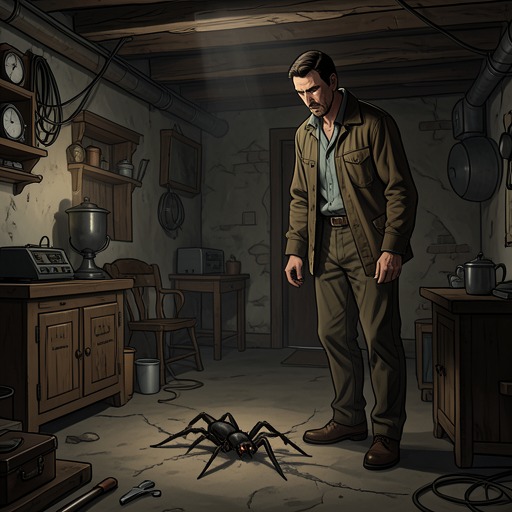
The Shrinking ManScott Carey—black widow predator-prey conflict is a sustained contest in which shrinking transforms an ordinary cellar into a dangerous landscape and reverses the apparent balance between human and animal. The black widow spider becomes a recurring threat, while Scott’s escapes and improvised resistance offer only intervals of safety: even when he drives it away with a pin, it remains alive, and he knows that his shrinking will make future confrontations harder.
Scale and the First Pursuit
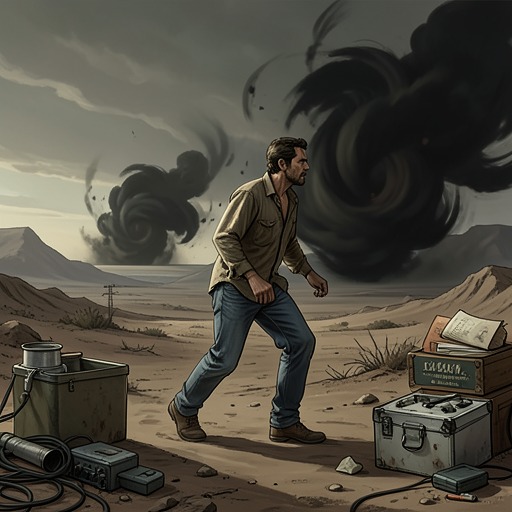
The conflict first appears as a chase across shadowed sand. The spider rushes toward Scott on its long legs, its body raised high, and his fear briefly leaves him unable to move. A sudden flare from a steel-encased flame breaks that paralysis; Scott turns and runs through alternating light and darkness while the spider follows. The encounter establishes a basic pattern that will govern their later contests: the spider advances, Scott must react, and survival depends on finding a moment or obstacle that lets him escape.
The pursuit continues into a canyon-like space. Scott limps across its floor toward a pile of enormous logs as the spider drops after him. He squeezes into a narrow gap between two logs, where the confined space prevents the spider from following. The barrier does not defeat the pursuer, but it interrupts the chase long enough for Scott to hide. When the spider searches over the logs, he waits until the scratching has stopped before backing out and checking his surroundings. He then sees it climbing a sheer wall, and recognizes that he has gained only temporary safety.
That first pursuit is also a delayed revelation about scale. The towering flame is an oil burner, the red, serpent-like object is a coiled garden hose, and the setting is Carey's cellar. The apparent wilderness is a domestic space made immense by Scott’s altered size; the spider is identified as a black widow spider. This change in perspective gives their conflict its defining imbalance. Familiar household objects can serve as terrain or shelter, but they do not make the cellar safe, and the spider’s size and mobility turn its ordinary features into hazards.
A Growing Predator and a Failing Shelter
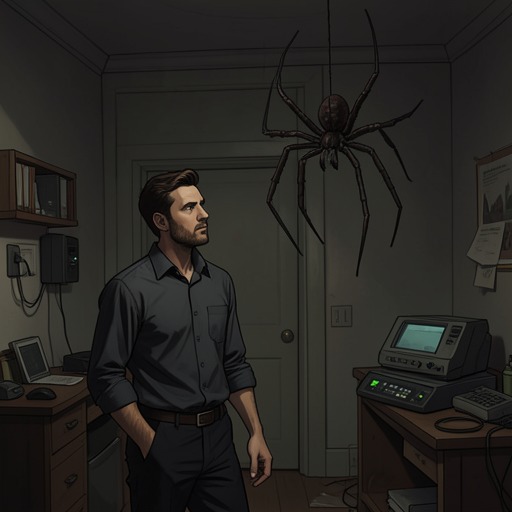
The spider returns to Scott’s box-top shelter at about eleven o’clock. It moves over the top and down its sides, searching for an opening while Scott remains beneath it. The account identifies the black widow spider by its scarlet hourglass marking and its poisonous bite, emphasizing that the threat is not merely a matter of size. More immediately, the spider is already almost as large as Scott. He expects that within days it will match and then surpass him, a prospect that makes the shelter feel less like protection than a short reprieve.
Scott has been trying to escape the cellar for five weeks, and by this point he is only one-sixth of his former size. The approaching spider therefore changes the meaning of time: each day of continued shrinking threatens to increase the predator’s advantage. When one of its legs reaches through a slight tear in the box top, the danger becomes tangible, though it does not get closer than five inches from his bed. Scott cries out for it to go away, but the spider continues moving around the shelter in an apparent effort to get in. It eventually leaves, and he falls into troubled sleep, but the episode brings no lasting resolution. The shelter has delayed the encounter, not removed the threat.
The Pin and a Brief Reversal
Later, after hauling food across the cellar toward the water heater where he sleeps, Scott finds the spider waiting at the top of the cement block. The food has offered a prospect of warmth and shelter, but the sight of the spider turns that return into another flight. Scott runs into one of two passages through the block, and the chase continues through the cellar’s clutter. With no clear opening available, he falls into an open sewing box as the spider closes in.
His hand finds a metal pin. Scott lifts it with both hands and drives it toward the spider as it leaps at him. The pin acts as a spear, forcing the spider back; when it charges again, he braces himself and uses the point a second time. The encounter is a reversal of the earlier pursuits: rather than escape behind a barrier, Scott confronts the spider directly with an object large enough to function as a weapon at his scale. The spider eventually moves away, and Scott realizes that he has chased it off.
His relief is real but limited. The pin falls from his hands as exhaustion overtakes him, and for a while he rests against the object that has saved his life. Then the unresolved danger returns to his thoughts. The spider is still alive and might be waiting outside or near his sleeping place; Scott also doubts that he can carry the pin everywhere, or even manage it after another day of shrinking. The victory changes the immediate outcome of the encounter, not the structure of the conflict. He has made the spider retreat, but cannot count on repeating the same defense.
Persistent Danger and the Limits of Resistance
The spider’s growing advantage is especially clear when Scott later searches the cellar for the pin and cannot find it. He considers whether a giant has kicked it away or whether it has become embedded in the sole of a shoe, but has no way to recover it. Rather than seek another, he continues toward the water pump. His response marks a point of depletion: beyond attending to bodily necessities, he feels little concern for anything. Yet this exhaustion does not amount to acceptance of the spider. He still cannot reconcile himself to it, and the thought of its presence remains a source of horror.
Scott imagines that it may be crouched in a web on the cliff wall, but that possibility is not confirmed. What he does know is the scale of the danger: the spider is now as tall as he is, its body has three times his volume, and its legs are as thick as his. He pauses at the edge of the descent toward water and considers whether to give up on reaching it, then continues down the thread despite fearing the spider might be below. The conflict therefore persists even when the spider is not in sight. It shapes Scott’s choices about shelter, food, water, and movement, and can turn an ordinary task into a risk he must accept.
Significance of the Conflict
The predator-prey relationship is made through successive changes in scale and advantage. At first, Scott survives by running and by slipping through a space too narrow for the spider. Later, a shelter and the distance it affords cannot prevent the spider from searching for him, and a pin provides a temporary means of resistance. As he continues to shrink, however, the tools and routes on which he depends become harder to use. The spider’s growth relative to Scott makes each escape feel provisional rather than conclusive.
The cellar’s domestic contents sharpen that reversal. Logs, a box top, a cement block, a sewing box, and a pin are not simply background objects: each alters what Scott can do in a particular encounter. Some provide cover or passage; one becomes a weapon. Their usefulness is conditional, and none ends the danger. Through this conflict, the story makes survival a practical sequence of judgments—where to hide, when to move, whether to descend for water—under conditions that are continually worsening. Scott’s successful resistance matters, but the living spider and his diminishing capacity ensure that it cannot be mistaken for a final victory.